

The nextjs-website resource is designed to deploy Next.js applications to AWS. It leverages serverless technologies like AWS Lambda and Lambda@Edge to run your application efficiently. Stacktape automatically provisions and configures all the necessary AWS resources, so you can focus on writing your application code.
Basic use of
nextjs-webresource
How it Works
Stacktape uses the open-source project OpenNEXT to build your Next.js application, making it compatible with AWS Lambda. Behind the scenes, Stacktape provisions a set of AWS resources to host your app:
| Component | Type | Description |
|---|---|---|
| Server function | Lambda or Lambda@Edge | Runs your Next.js server logic. |
| Asset Bucket | S3 bucket | Stores static assets (like images, CSS) and cached assets. |
| Image optimization function | Lambda | Handles on-the-fly image optimization for the Next.js <Image> component. |
| CloudFront distribution | CDN | A CDN that caches and distributes your website content globally for low latency. |
| Revalidation function | Lambda | Handles content revalidation when using Incremental Static Regeneration (ISR). |
| Revalidation queue | SQS Queue | A message queue used by the server function to trigger the revalidation function. |
| Revalidation table | DynamoDB table | A NoSQL database that supports Next.js revalidateTag for on-demand revalidation. |
| Revalidation inserter | Lambda | Populates the revalidation table during deployment. |
| Warmer function (Optional) | Lambda | Keeps the server function warm to prevent cold starts (not available for Lambda@Edge). |
For more information refer to OpenNext docs.
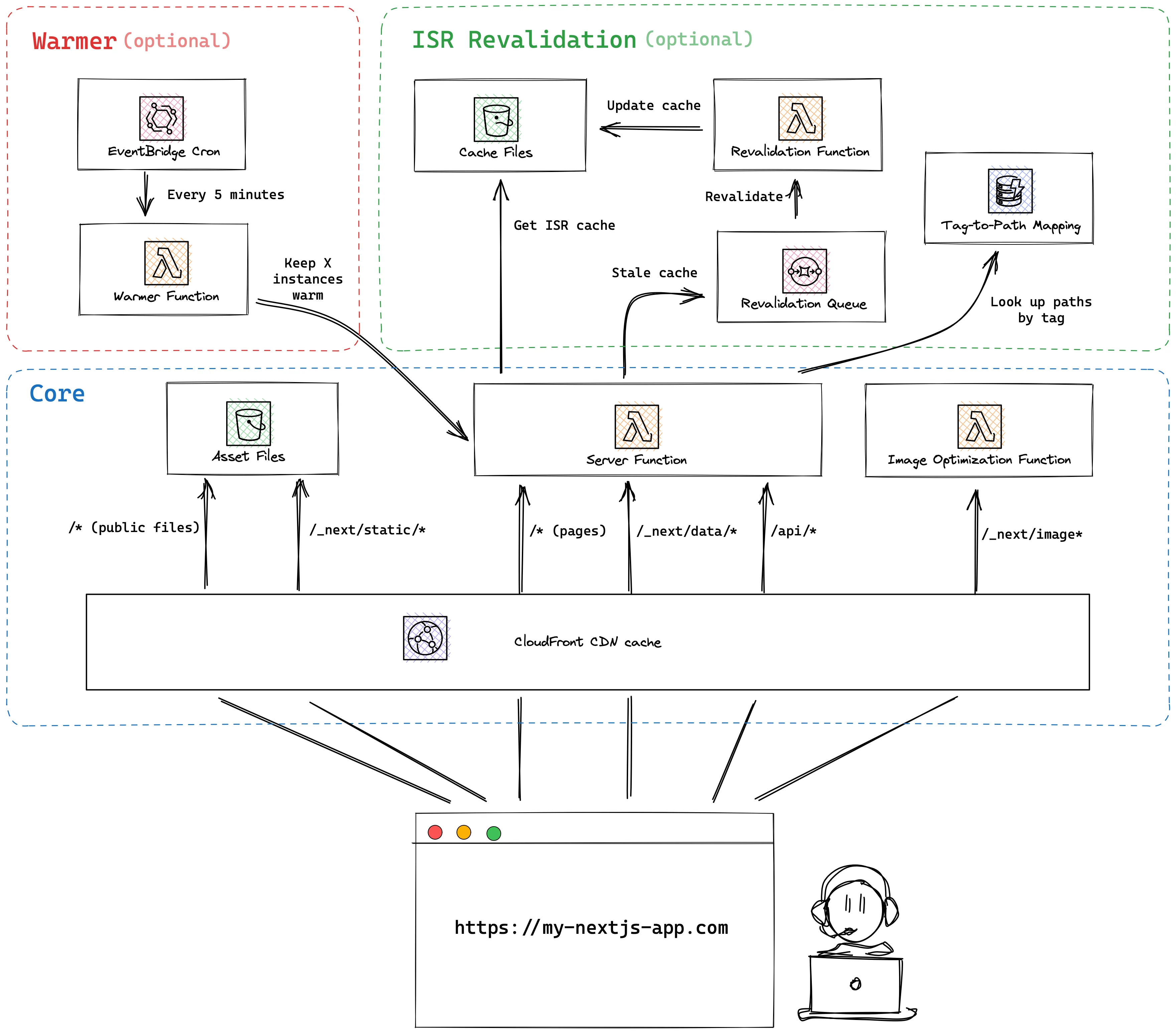
Edge Deployments
To deploy your Next.js application to the edge for lower latency, you can use Lambda@Edge by setting the useEdgeLambda property to true. This deploys your server function to CDN locations around the world.
Trade-offs: Slower deploys, no warmServerInstances, no response streaming.
Performance Optimization
Mitigating Cold Starts
To mitigate cold starts and ensure your server function responds quickly, you can enable a warmer. This keeps a specified number of function instances active. By default, the warmer is disabled. This feature is not available when using useEdgeLambda.
A separate "warmer" function periodically pings the SSR Lambda. Not available with useEdgeLambda: true.
Security
Web Application Firewall
You can protect your Next.js application from common web exploits by attaching a web-app-firewall. This can help prevent attacks that could affect your application's availability, compromise security, or consume excessive resources.
Environment variables
You can inject environment variables into the server function. These variables are available at build time and runtime.
A list of environment variables to pass to the script or command.
Values can be:
- A static string, number, or boolean.
- The result of a custom directive.
- A reference to another resource's parameter using the `$ResourceParam` directive.
- A value from a secret using the `$Secret` directive.
Custom Domain Names
You can configure custom domains for your Next.js application. Stacktape will automatically provision an SSL certificate and configure DNS routing.
Your domain must be added as a Route53 hosted zone in your AWS account first.
DomainConfigurationAPI referenceParent:NextjsWebdomainNameRequired
Your domain name (e.g., mydomain.com or api.mydomain.com).
Type: string
Don't include the protocol (https://). The domain must have a Route53 hosted zone
in your AWS account, with your registrar's nameservers pointing to it.
Stacktape automatically creates a DNS record and provisions a free TLS certificate.
customCertificateArn
Use your own TLS certificate instead of the auto-generated one.
Type: string
Provide the ARN of an ACM certificate from your AWS account. Only needed if you have specific certificate requirements (e.g., EV/OV certs). By default, Stacktape provisions and renews free certificates automatically.
disableDnsRecordCreation
Skip DNS record creation for this domain.
Type: boolean
Set to true if you manage DNS records yourself (e.g., through Cloudflare or another DNS provider).
Stacktape will still provision the TLS certificate but won't touch your DNS.
Accessing Other Resources
By default, most AWS resources are not allowed to communicate with each other. This is a security measure to ensure resource isolation. To allow your Next.js application to access other resources, you need to grant permissions explicitly.
- IAM Permissions: Access to most AWS services is controlled by IAM (Identity and Access Management). Stacktape automatically manages the necessary permissions for the resources it creates.
- Relational Databases: Relational Databases use their own access control (a connection string with a username and password) and are not managed by IAM. They are accessible by default unless you configure more restrictive access controls.
If your Next.js application needs to communicate with other resources in your stack, you can grant permissions in two ways:
Using connectTo
The connectTo property is a simplified way to grant access to other Stacktape-managed resources. Stacktape will automatically configure the required IAM permissions and inject connection details as environment variables into your function.
List the names of resources this workload needs to communicate with. Stacktape automatically:
- Grants IAM permissions (e.g., S3 read/write, SQS send/receive)
- Opens network access (security group rules for databases, Redis)
- Injects environment variables with connection details:
STP_[RESOURCE_NAME]_[PARAM]
Example: connectTo: ["myDatabase", "myBucket"] gives this workload full access to both
resources and injects STP_MY_DATABASE_CONNECTION_STRING, STP_MY_BUCKET_NAME, etc.
Using iamRoleStatements
For more granular control, you can provide raw IAM role statements. This allows you to define precise permissions for accessing any AWS resource, including those not managed by Stacktape.
Known Issues
Here are some known issues and workarounds when deploying Next.js applications with Stacktape.
Bundle Size
Next.js can sometimes include development dependencies in the production bundle, which significantly increases its size. To prevent this, add the following configuration to your next.config.js file:
Fetch Behavior for ISR
Applies only to Next.js v13.5.1 and later.
A bug in Next.js can cause inconsistent revalidation behavior when using ISR. It may use the lowest revalidate value from all fetch calls on a page, ignoring their individual settings. To fix this, add the following snippet to your root layout component:
Pricing
All resources provisioned for your Next.js application are pay-per-use. This means you pay nothing for idle resources and only for what you use. As your traffic grows, your costs will increase, but they are generally much lower than managed hosting providers like Vercel.
Cost Breakdown
CloudFront CDN
CloudFront serves as a CDN, caching your content in edge locations close to your users.
- Data Transfer: ~$0.085 per GB (first 1 TB/month is free)
- HTTPS Requests: ~$0.0085 per 10,000 requests (first 10,000,000/month are free)
For current pricing, see the AWS CloudFront Pricing page.
AWS Lambda
Costs depend on whether you use regional Lambda or Lambda@Edge.
Regional AWS Lambda
- Execution Duration: ~$0.0000000167 per millisecond (with 1024MB memory)
- Requests: $0.20 per 1 million requests
Lambda@Edge
- Execution Duration: ~$0.00000005001 per millisecond (with 1024MB memory)
- Requests: $0.60 per 1 million requests
For current pricing, see the AWS Lambda Pricing page.
S3 for Caching
A S3 bucket is used to store the cache for ISR and fetch requests.
GetObject: ~$0.0004 per 1,000 requests (reading from cache)PutObject: ~$0.005 per 1,000 requests (writing to cache)
For current pricing, see the AWS S3 Pricing page.
DynamoDB for Cache Tags
A DynamoDB table stores cache tags for on-demand revalidation.
- Read Requests: ~$0.25 per 1 million read units
- Write Requests: ~$1.25 per 1 million write units
For current pricing, see the AWS DynamoDB Pricing page.
Example Pricing
The following example is a rough estimate for a website with 300,000 monthly visitors. Actual costs can vary significantly based on your application's caching strategy, dynamic content, and API usage.
Assumptions
- Monthly Visitors: 300,000
- Page Views per Visitor: 3
- Cache Hit Rate: 50% of page views are served from the CDN cache.
- API Calls per Page: 2 API calls for each page view that hits the server.
This results in:
- Total Page Views: 900,000
- Server Page Views: 450,000
- Total Server Requests: 1,350,000 (450,000 page views + 900,000 API calls)
Monthly Cost Estimate
| Service | Calculation | Estimated Cost |
|---|---|---|
| CloudFront | Within free tier limits | $0 |
| AWS Lambda | 675,000 requests, 100ms duration each | $1.26 |
| S3 Storage | 675,000 reads and writes | $3.65 |
| DynamoDB | 675,000 reads and writes | $1.01 |
| Total | ~$5.92 per month |
API reference
NextjsWebAPI referencetypeRequired
Type: string "nextjs-web"
properties.appDirectoryRequired
Directory containing your next.config.js. For monorepos, point to the Next.js workspace.
Type: string
properties.serverLambda
Customize the SSR Lambda function (memory, timeout, VPC, logging).
properties.warmServerInstances
Number of Lambda instances to keep warm (pre-initialized) to reduce cold starts.
Type: number
A separate "warmer" function periodically pings the SSR Lambda. Not available with useEdgeLambda: true.
properties.useEdgeLambda
Run SSR at CloudFront edge locations for lower latency worldwide.
Type: boolean
Trade-offs: Slower deploys, no warmServerInstances, no response streaming.
properties.buildCommand
Override the default next build command.
Type: string
properties.dev
Dev server config for stacktape dev. Defaults to next dev.
Type: Object
properties.fileOptions
Set custom headers (e.g., Cache-Control) for static files matching a pattern.
Type: Array of DirectoryUploadFilter
properties.environment
Environment variables for the SSR function. Use $ResourceParam() or $Secret() for dynamic values.
Type: Array of EnvironmentVar
properties.customDomains
Attach custom domains with auto-managed DNS records and TLS certificates.
Type: Array of DomainConfiguration
Prerequisite: A Route 53 hosted zone for your domain must exist in your AWS account.
properties.useFirewall
Name of a web-app-firewall resource to protect this app. Firewall scope must be cdn.
Type: string
properties.streamingEnabled
Stream SSR responses for faster Time to First Byte and up to 20 MB response size (vs 6 MB default).
Type: boolean
Not compatible with useEdgeLambda: true.
properties.cdn
CDN cache controls for SSR routes and specific path patterns.
Type: SsrWebCdnConfig
properties.connectTo
Give this resource access to other resources in your stack.
Type: Array of string
List the names of resources this workload needs to communicate with. Stacktape automatically:
- Grants IAM permissions (e.g., S3 read/write, SQS send/receive)
- Opens network access (security group rules for databases, Redis)
- Injects environment variables with connection details:
STP_[RESOURCE_NAME]_[PARAM]
Example: connectTo: ["myDatabase", "myBucket"] gives this workload full access to both
resources and injects STP_MY_DATABASE_CONNECTION_STRING, STP_MY_BUCKET_NAME, etc.
properties.iamRoleStatements
Raw IAM policy statements for permissions not covered by connectTo.
Type: Array of StpIamRoleStatement
Added as a separate policy alongside auto-generated permissions. Use this for accessing AWS services directly (e.g., Rekognition, Textract, Bedrock).
overrides
Escape hatch to modify the underlying CloudFormation resources Stacktape creates.
Type: Object
Use dot-notation paths to override specific properties on any child resource.
Find resource logical IDs with stacktape stack-info --detailed.
overrides:
  MyDbInstance:
    Properties.StorageEncrypted: true
NextjsServerLambdaPropertiesAPI referenceParent:NextjsWebmemoryDefault: 1024
Memory in MB (128–10,240). CPU scales proportionally — 1,769 MB = 1 vCPU.
Type: number
timeoutDefault: 30
Max execution time in seconds. Max: 30.
Type: number
logging
Logging config. Logs are sent to CloudWatch. View with stacktape logs or in the AWS console.
Type: LambdaFunctionLogging
joinDefaultVpc
Connect to VPC resources (databases, Redis). Warning: function loses direct internet access.
Type: boolean
S3 and DynamoDB remain accessible via auto-created VPC endpoints.
LambdaFunctionLoggingAPI referenceParent:NextjsServerLambdaPropertiesdisabled
Disable CloudWatch logging entirely.
Type: boolean
retentionDaysDefault: 180
How many days to keep logs. Longer retention = higher storage cost.
Type: number ENUM
Possible values: 13571430609012015018036540054573118273653
logForwarding
Forward logs to an external service (Datadog, Highlight.io, or any HTTP endpoint).
Type: HttpEndpointLogForwarding or HighlightLogForwarding or DatadogLogForwarding
Uses Kinesis Data Firehose (~$0.03/GB). Failed deliveries go to a backup S3 bucket.
EnvironmentVarAPI referenceParent:NextjsWebnameRequired
Environment variable name (e.g., DATABASE_URL, API_KEY).
Type: string
valueRequired
Environment variable value. Numbers and booleans are converted to strings.
Type: string or number or boolean
DirectoryUploadFilterAPI referenceParent:NextjsWebincludePatternRequired
Glob pattern for files this rule applies to (e.g., *.html, assets/**).
Type: string
excludePattern
Glob pattern for files to exclude even if they match includePattern.
Type: string
headers
HTTP headers (e.g., Cache-Control) for matching files. Forwarded through CDN to the browser.
Type: Array of KeyValuePair
tags
Tags for matching files. Can be used to target files with lifecycleRules.
Type: Array of KeyValuePair